
Tech Trends 2026 for Startups & MSMEs: From Tools to Systems
For years, technology was judged by features. In 2026, it’s judged by outcomes. As businesses move beyond tools and dashboards, systems - how work actually flows, are becoming the real competitive advantage.
For years, technology trends were defined by features. Faster software. Smarter dashboards. New tools for every new problem.
However, 2026 represents a definite point of change.
Technology is no longer judged by what it can do, but by how effectively it helps businesses operate—with clarity, speed, and consistency.
According to research from Deloitte, organizations are moving past isolated experiments with AI and automation and focusing on measurable business impact. Similarly, Gartner highlights that the most strategic technology trends for 2026 revolve around domain intelligence, autonomous systems, and real-world execution.
From Floww’s perspective, these trends all point to one conclusion:
In 2026, systems—not tools—become the true competitive advantage.
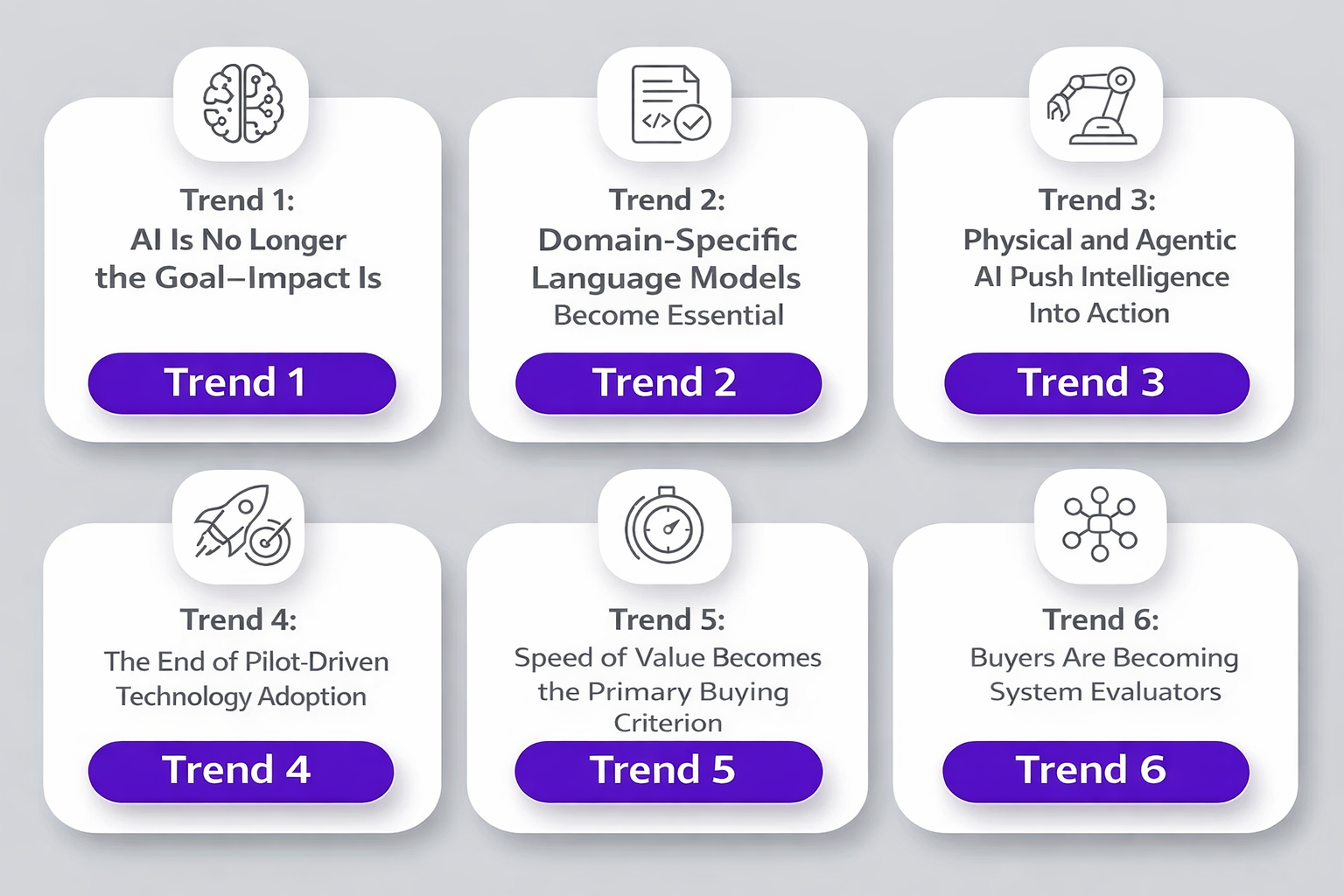
Trend 1: AI Is No Longer the Goal—Impact Is
Across industries, the conversation around artificial intelligence has matured.
The question has shifted from: “What can we do with AI?” to “How do we translate from trial to business issues in the ‘real world?”
AI on its own does not improve productivity. AI embedded inside systems does.
When intelligence operates within structured workflows—connecting people, decisions, and execution—it delivers measurable results. When AI is layered on top of disconnected tools, it often accelerates confusion instead of clarity.
This reinforces a foundational truth for 2026:
Systems come before intelligence. Structure enables AI to create real impact.
Trend 2: Domain-Specific Language Models Become Essential
General-purpose AI models are powerful, but in business environments they often lack context.
That’s why Gartner identifies Domain-Specific Language Models (DSLMs) as a major strategic trend for 2026. These models are trained on focused, industry-specific data, enabling:
- Higher accuracy
- Better compliance
- Lower operational risk
- Faster execution of domain rules
For businesses, especially MSMEs, this shift highlights a key insight:
Context matters more than raw capability.
Tools that understand how work actually happens inside a business outperform generic tools that merely respond to prompts.
Trend 3: Physical and Agentic AI Push Intelligence Into Action
Another defining shift in 2026 is the rise of agentic and physical AI—systems that don’t just assist, but act autonomously.
These technologies move intelligence beyond dashboards into real-world execution, coordinating tasks, making decisions, and adapting to changing conditions.
The implication is significant:
- AI is no longer confined to screens
- Intelligence must operate inside workflows
- Automation must connect decisions to execution
This is why buyers are no longer looking for smarter bots. They are looking for systems that actually get work done.
Trend 4: The End of Pilot-Driven Technology Adoption
Deloitte’s research emphasizes a critical shift:
The era of pilots is over. Real value now comes from embedding technology at the core of business operations.
In 2026, organizations are no longer impressed by proof-of-concept demos. They expect technology to:
- Reduce complexity
- Improve coordination
- Deliver outcomes consistently
This requires redesigning workflows—not automating broken ones.
Technology decisions are now evaluated through a system lens, not a feature checklist.
Trend 5: Speed of Value Becomes the Primary Buying Criterion
In the past, software was judged by feature depth.
In 2026, it is judged by speed of value.
Buyers now ask:
- Can we see clarity immediately?
- Can teams use this without months of training?
- Does this improve visibility in the first week?
This shift is especially pronounced among MSMEs, where delayed value directly impacts revenue, morale, and momentum.
Systems that deliver fast, visible outcomes consistently outperform tools that promise depth but require long adoption cycles.
Trend 6: Buyers Are Becoming System Evaluators
One of the most important—but least discussed—changes in 2026 is how buyers evaluate technology.
They are no longer tool evaluators. They are system evaluators.
They assess:
- How well workflows are connected
- Whether information flows without friction
- If decisions are visible without constant follow-ups
- Whether the system reduces cognitive load
This conceptual shift naturally favors integrated systems over isolated tools.
What These Trends Mean for MSMEs in 2026
If 2025 was about experimenting with new technologies, 2026 is about making those technologies matter.
The winners will not be:
- Companies with the most features
- Companies with the flashiest AI demos
- Companies with the most dashboards
They will be companies that build coherent business systems—systems that:
- Remove ambiguity
- Connect people, work, and decisions
- Scale without chaos
- Embed intelligence with context
- Deliver value immediately
Floww’s Perspective
At Floww, we see these trends not as abstract predictions, but as clear strategic signals.
- Businesses are done with disconnected tools
- AI must live inside workflows to be effective
- Visibility matters more than automation
- Impact matters more than experimentation
That is why we position Atom Suite not as another software product, but as a Lightweight Operating System for MSMEs—a system designed around how work actually happens, not how tools are traditionally sold.
In 2026, this distinction is not optional.
It is inevitable.
Final Thought
2026 isn’t about adopting more technology. It’s about choosing systems that make businesses easier to run.
That's where the real tech trend lies in shaping the future.
Why global SaaS assumptions fail Indian startups and MSMEs